
Celestial Divinities: An Understanding of Cultural Astronomy. 07
The Navajo Sky

This is part of a presentation that was made in collaboration with a Navajo (Dine) woman for an Anthropology class at the University of Utah in the Spring of 2010. The class was Native American Religions. I did The Sky and she did The Earth. It was a very meaningful experience.
THE SACRED LANDSCAPE OF THE NAVAJO: EARTH AND SKY
University of Utah. Salt Lake City UT. March 2010
THE SKY.
Sacred Landscape
The sacred landscape of the Navajo flows from deep within the earth to the farthest reaches of the universe. (Maryboy, 2005) It is manifested in hard red rock and in the invisible realm of dreams and visions. (Nabokov, 2006) The sacred landscape does not end at the horizon. The sacred landscape extends to the heavens as well. (Williamson, 1984) The horizon is where Earth and Sky meet, an extremely significant interface in traditional culture. (Gill, 1981) The relationship between celestial objects and terrestrial markers has a place in mythology, ceremonial observances, and agricultural cycles. (Williamson, 1984)
Cultural Astronomy
The sky is a cultural resource. The study of the sky represents for the anthropologist one area of human interrelationships that is immutable, that has not been physically altered, that remains a raw resource that is directly accessible to all of us. (Ruggles, 1993: 732) Astronomy defines sacred directions and cosmic patterns; provides a field for cosmic mythology; establishes ritual sites and shrines; inspires a ritual planting calendar; and sets times for hunting and gathering. (Zeilik, 1989) It must be recognized that much information has been transmitted orally for generations, some of which has not been revealed to the uninitiated within the group; and through unfortunate experiences with European Americans, has been withheld from outsiders. (Williamson, 1984) The Navajo lifeway is holistic, inclusive, and interrelated and interdependent. (Gill, 1981) Meaning is given to and integrated with all the elements of the indigenous world, whether visible or invisible; whether past, present, or future; whether on the surface of the world, below it, or far above it. (Nabokov, 2006) The cycles apparent in the heavens are related to activity on the earth. Seasonality is interpreted both celestially and terrestrially; correspondences are developed between the sun, moon, planets, and stars, and with human behavior. Order is perceived in the natural world and the people seek to maintain it through ritual and ceremony. (Williamson,1984)
Stories have been developed to give meaning to the universe, gods and spirits with super human powers and multiple identities populate the cosmos. (Ruggles, 1993) Relationships of reciprocity have evolved between the people and these deities, and the tenuous existence on this planet has been sustained. (Nabokov, 2006) Order is a primary concern of culture; "direction is essential to life." (Williamson, 1984: 303) Direction is established through astronomy. The North Star (Polaris) is only a temporary marker of North. 2000 years ago there was no significant star to identify the celestial axis. The position of the sun is our reliable determinant of direction. A pole (gnomon) planted vertically in the ground casts a shadow of varying length and orientation from the sun throughout the day. The shortest shadow appears at solar noon, when the sun is highest in the sky and due south. Marking two shadows of equal length on each side of noon, connecting them with a straight line, laying out a line perpendicular to and bisecting it, gives a true north-south axis. East-west then is at right angles, or the line connecting the two marked shadows. (Williamson, 1984)
The sun completes its cycle in one year. In the mid-latitudes north and south of the equator, the sun's arc across the sky gives rise to the concept of the axis of the world, axis mundi. (Ruggles, 1993) The sun reaches its northernmost position at the summer solstice, most northerly sunrise, highest elevation in the sky at noon, most northerly sunset, and the longest daylight of the year. Conversely, the winter solstice sees the sun most southerly with the least amount of daylight. The return of the sun northward following the winter solstice brings hope and renewal to the people and to the earth. Important ceremonies have been developed to commemorate these two extremes in the sun's course. Some have said that the medicine men manipulate the people into believing they have control over the movements of the sun, and have the power to bring back its life giving force. (Williamson, 1984) I believe that these ceremonies are an expression of gratitude that maintains the equilibrium within the community and acknowledges the fragile relationship that exists between the people and the natural world. The risings and settings of the sun can be recorded throughout the year by observing their changing locations along the horizon. Significantly distinct features can be identified and remembered, to mark the sun's progression, and be used to anticipate and prepare for the solstitial events. (Williamson, 1984)
The moon passes through its own monthly cycle as well as a yearly cycle. We recognize the daily changes of its phases. A complete round from full moon to full moon takes about 29 days. The full moons also appear in different positions in the sky, opposite, of course, to where the sun is. Ceremonies are frequently determined by the timing of a full moon. (Ellis, 1975) Agricultural cycles are measured by a correspondence of the moon with the sun. (Maryboy, 2005)
The planets play a minor role in Native American astronomy in North America. Venus, quite bright, is given the most attention. It has a dual identity as Morning Star and Evening Star, known by other names as the Hero Twins. (Ellis, 1975)
The stars are important because they have assumed the identities and powers of deity. The stars were created to help people remember the right way to live. (Griffin-Pierce, 1992) They also can be called upon to provide medicine and power in time for healing. They provide guidance to determine proper ceremonies and knowledge for instruction. (Maryboy, 2005) Once their identities are known, the movement of the stars through the seasons of the year can be followed without any earth-bound referents. (Williamson, 1984)
Anasazi
The astronomy of the Anasazi has been much researched and hotly debated. Interpretation by non-Native archaeologists is imprecise if not impossible. Native American information does not coincide with the archaeological record. And the people are reluctant to discuss sacred matters. (Lister, 2005) There seems to be some consensus that astronomy played an important part in the life of the Ancient Ones. Certain important sites seem to have been intentionally constructed with astronomical alignments. Some towers have been interpreted as observatories. (Ellis, 1975) The kivas are believed to recreate indigenous cosmology, the people's place of emergence. (Malville, 2005) Described as "hierophanies of space and time," (Malville, 2005: 76) the sacred is manifested through architectural constructions, natural rock formations, intentional designs on rock faces, definitions of solstice sunrises and sunsets, and the unique interplay of light and shadow. (Malville, 2005) Much of the interpretation of Anasazi architecture and artifacts comes from the use of analogy to contemporary Zuni and Hopi practices. (Williamson, 1984) However, present practices are not a determinant of past practices. (Lister, 2005) The argument being that the Anasazi were a settled people who depended on agriculture, as are the contemporary Pueblo people, whereas the Navajo are more nomadic, build hogans, and do not live in aggregate communities. (Williamson, 1984)
Navajo Astronomy
The astronomy of the Navajo comprises beliefs and practices regarding the sun, the moon, and the stars. Observing the sky is done for religious, medicinal, and agricultural purposes (Maryboy, 2005) The Navajo recognize a correspondence between the happenings above the world, on the surface of the world, and beneath the world. The cosmos is divided into four quarters and each has an associated color. (Maryboy, 2005) From the time before emergence, before there was a sun or a moon, in the dimness of the underworld, the passage of time was determined by "the shifting of the dominance of color from one quadrant to another through each of the four cardinal directions." (Gill, 1981: 51) East is white and signifies birth. South is blue and represents childhood. The west is yellow for maturity. And north is black in old age. (Maryboy, 2005) There are four Big Stars that correspond in direction and color. (Haile, 1947) They play a part in ceremony, but they may not be literal objects, but figurative representations. (Andrews, 2010). Their identity has not been revealed. There are a number of stories about the stars, but they are only to be told during the winter. To protect the balance of the world, I will allude to the creation of the sky, without relating the tale. Talking God created Earth and Sky in the hogan of creation. He created the stars and began placing them in order in the sky. Coyote came along and scattered the rest.
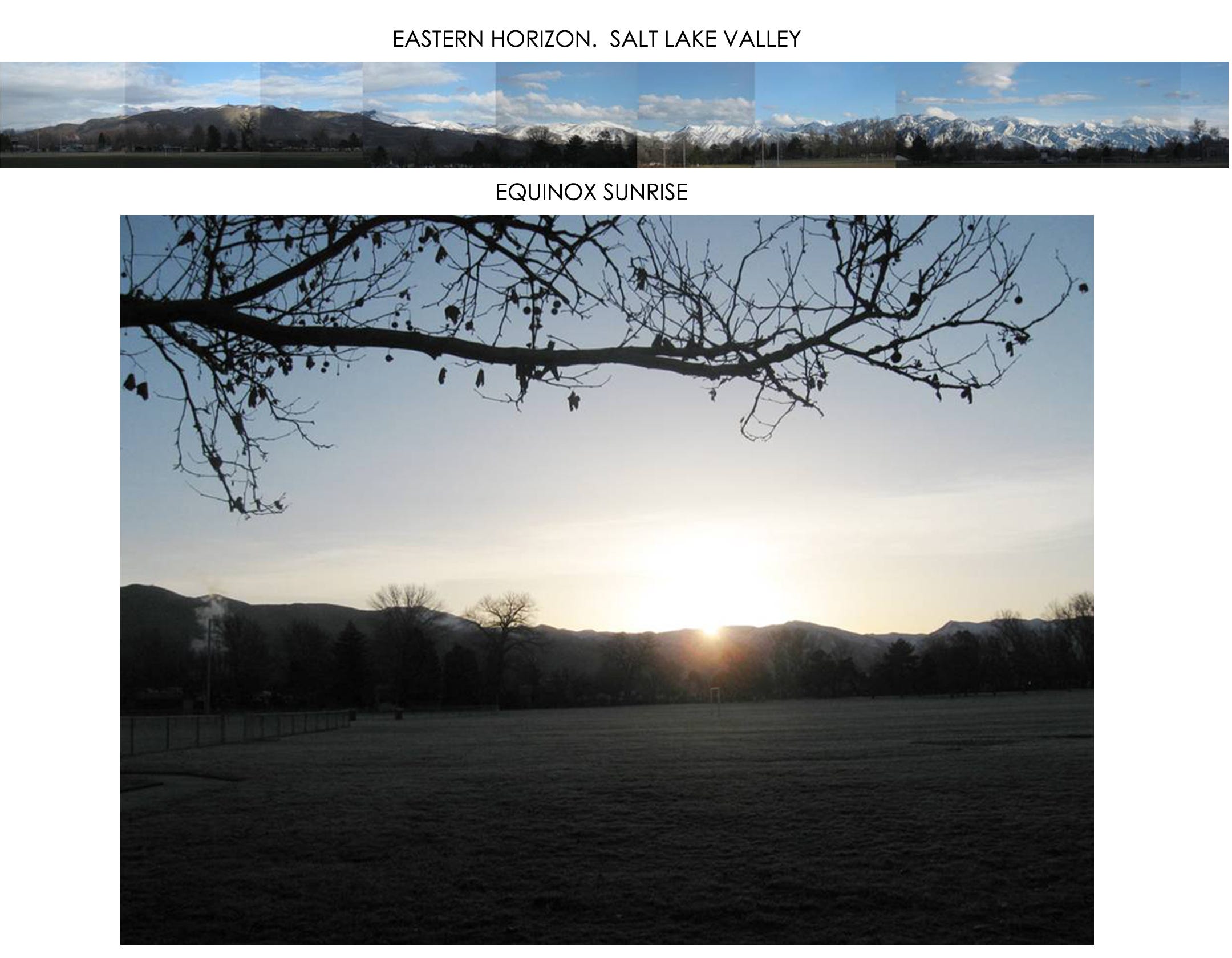
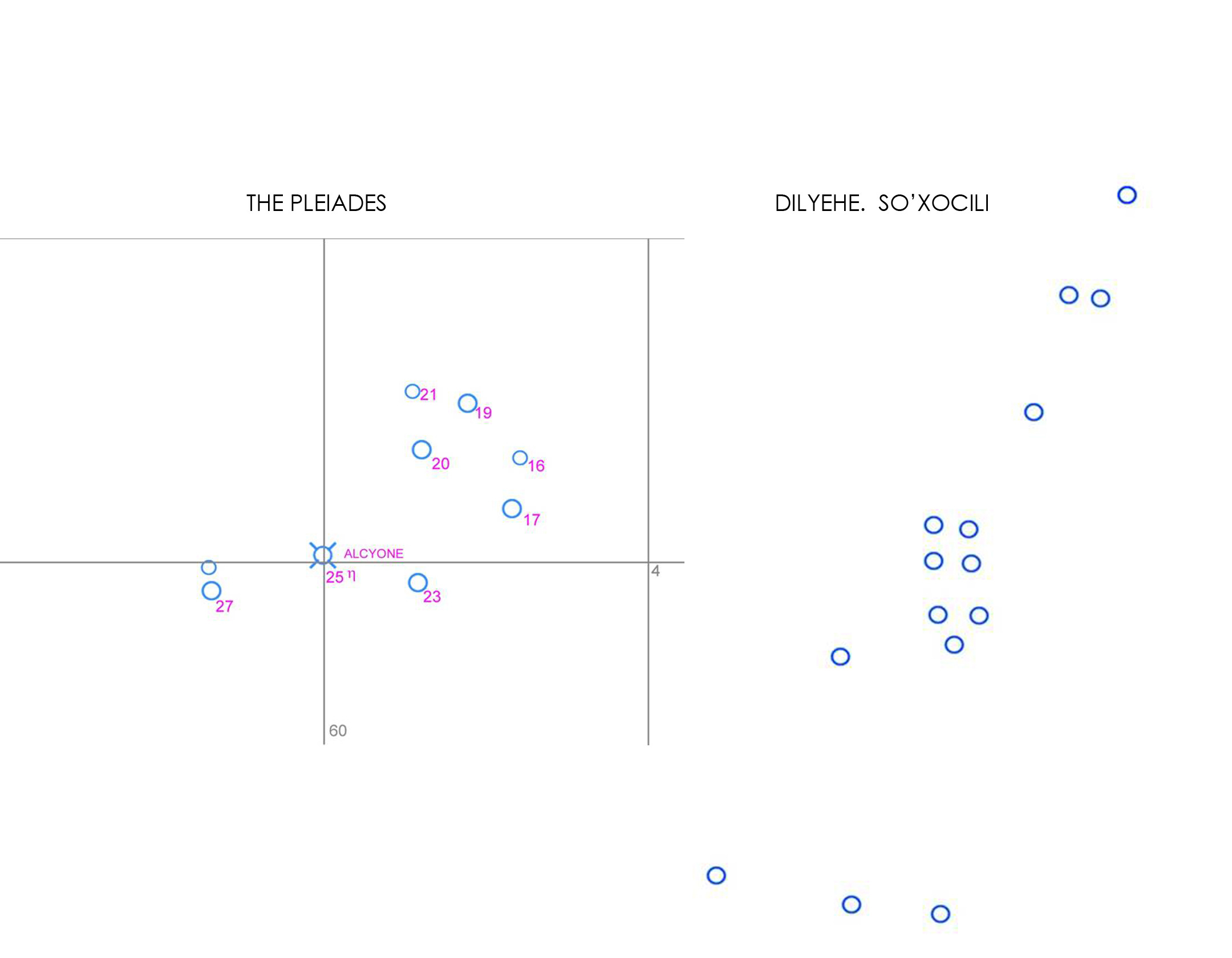
The named constellations are related in pairs, a common feature in Navajo culture. The Pleiades (Dilyehe) is of particular importance. Of all the constellations, it is the most closely associated with Talking God. It is used as a marker of time. When it is visible, it serves as a nighttime clock. Its position in the sky is a determinant of ceremonies. It is a seasonal reminder in the late autumn that frost is approaching, and its disappearance from the sky in spring signals the beginning of planting. Associated with Dilyehe is Orion (Atse Etsozi) The First Slender One, a hunter and warrior. Atse Etsozi is paired with Atse Etsoh, The First Big One, part of Scorpius, which is opposite in the sky. An elder imbued with wisdom, the decline of this constellation in late summer is a sign for the deer hunt. Revolving around the north celestial pole are Nahookos Bika, the Male Whirling Figure, and Nahookos Biaad, the Female Whirling Figure. We know them as the Big Dipper and Cassiopeia. They represent Grandfather Provider and the Mother of Regeneration. They are in constant balance with each other around Biko, the cosmic center of the night sky, which on earth is the central hearth of the Navajo hogan. (Maryboy, 2005) The most important time to view the stars is just before dawn. The stars that become visible above the eastern horizon just before sunrise are given special significance.
The story of the Creation that is related to the stars concerns the dispersal of the Holy People, Diyin Dinee. They became the Inner Life of all the significant elements of the sacred landscape. (Gill, 1981) Though I have no specific evidence for their place in the sky, there are references to Star People, yotah nazlai, that are invited to attend ceremonies they helped to create (Haile, 1947)
Hozho
The essence of Navajo culture is to maintain balance in this world. It is expressed by the word hozho. "The Navajo does not look for beauty; he generates it within himself and projects it onto the universe. The Navajo says shil hozho 'with me there is beauty', shii hozho 'in me there is beauty', and shaa hozho 'from me beauty radiates'. Beauty is not 'out there' in things to be perceived by the perceptive and appreciative viewer; it is a creation of thought. Beauty is not so much a perceptual experience as it is a conceptual one." (Gary Witherspoon. 1977. Language and Art in the Navajo Universe. University of Michigan Press. Ann Arbor. p.151.in Brown,2001:79) The forces from the underworlds as well as ordinary human behavior can disruptive and create hocho. The forces of disorder are continually in contention with peace and harmony, there is constant interaction of all dualities: emergence, creation; lower worlds, earth's surface; chaos, organization; humans, Holy People; ours, theirs; and death, life. Ceremonies were created by the Holy People to be used to restore well-being and harmony. (Gill, 1981) Healing takes place through contact with sacred powers. One becomes a permanent part of the greater universe. Hozhoni is integration with the cosmos. Reciprocity is established between human and the supernatural, give and take. (Brown, 2001) After all, we are all stardust.
Ceremony
There are many ceremonies in Navajo religious life for differing occasions and purposes. A couple that apparently are more closely associated with the stars are Blessingway and Big Starway. Blessingway, hozhooji, is an expression of gratitude and seeks renewal through the recreation of the world as Changing Woman made it. As Frank Mitchell relates: "Blessingway was first used to place Earth and Sky in a position facing each other." (Gill, 1981: 61) It reinforces the proper relation between these complementary paired entities. Big Starway is a ceremony of Liberation, or recovery. Haayateeh is employed to go "down under the earth, up to the sky, and back to earth again"(Mary C. Wheelwright, Gill, 1981: 143) to restore the Inner Life to the individual who has lost it.
Conclusion
Gill relates that Navajo religion is a "...well-unified system of thought, expression, and action which is life-giving, meaning-giving, true, and sophisticated in the terms in which it is practiced by its believers and adherents." (Gill, 1981: xviii). Navajo freedom and creativity are uniquely expressed in adherence to formality.
For Maryboy, Navajo celestial knowledge reflects a holistic worldview. Each component represents a microcosmic totality; possesses life; is a dynamic portrayal of cycles, circles, and chaos. The stars are teachers and healers, providing guidance as to the right way of living, of maintaining hozho, and of curing illness. (Maryboy, 2005)
Navajo astronomy may well teach us what we need to know to avoid the apparent collapse of the world as we know it today, and to ensure a sustainable environment for our future generations.
It would appear that Navajo astronomy as a component of Navajo religion has remained intact and meaningful for many, many generations, despite efforts to debase it, marginalize it, and suppress it. It is likely that some aspects of it have been forgotten over time. It is also likely that the Navajo have borrowed from the Anasazi and from historical Pueblo people. It is also likely that much information has been retained, only recluded from public view, to preserve its authenticity and sacred character. The continuity of oral tradition, the interrelatedness of generations, and the intimacy with the landscape have preserved the Navajo religion and give it strength to endure.
BIBLIOGRAPHY
Andrews, Victoria. 2010. personal communication. Salt Lake City.
Brown, Joseph Epes. 2001. Teaching Spirits:
Understanding Native American Religious Traditions. Oxford University Press.
Ellis, Florence Hawley. 1975. "A Thousand Years of the Pueblo Sun-Moon-Star Calendar."
Foundations of New World Cultural Astronomy. Anthony Aveni, editor. 2008.
University Press of Colorado. Boulder
Gill, Sam D. 1981. Sacred Words: A Study of Navajo Religion and Prayer.
Greenwood Press. Greenwood CT.
Griffin-Pierce, Trudy. 1992. "The Hoogan and the Stars."
Foundations of New World Cultural Astronomy. Anthony Aveni, editor. 2008.
University Press of Colorado. Boulder
Haile, Berard, OFM. 1947. Starlore Among the Navajo.
Museum of Navajo Ceremonial Art. Santa Fe
Lister, Florence C. 2005. "Foreword."
Canyon Spirits: Beauty and Power in the Ancestral Puebloan World.
University of New Mexico Press. Albuquerque.
Malville, J. McKim. 2005. "Ancient Space and Time in the Canyons."
Canyon Spirits: Beauty and Power in the Ancestral Puebloan World.
University of New Mexico Press. Albuquerque.
Maryboy, Nancy C. and David Begay. 2005.
Sharing the Skies: Stories and Activities of the Navajo and Western Cosmos.
World Hope Foundation. Boulder CO. Indigenous Education Institute. Bluff UT.
Nabokov, Peter. 2006. Where Lightning Strikes:
The Lives of American Indian Sacred Places. Penguin Books Ltd. London.
Ruggles, Clive L. N. and Nicholas J. Saunders. 1993. "The Study of Cultural Astronomy."
Foundations of New World Cultural Astronomy. Anthony Aveni, editor. 2008.
University Press of Colorado. Boulder.
Williamson, Ray A. 1984. Living the Sky: The Cosmos of the American Indian.
Houghton Mifflin Company. Boston.
Zeilik, Michael. 1989. "Keeping the Sacred and Planting Calendar:
Archaeoastronomy in the Peublo Southwest."
Foundations of New World Cultural Astronomy. Anthony Aveni, editor. 2008.
University Press of Colorado. Boulder.